What actually makes a buggy “dune-rated” instead of just an off-road rental?
Tyre choice, ride height and suspension travel, tuned specifically for loose, shifting sand rather than gravel or a hard-packed trail. A buggy built for one doesn't automatically work for the other.
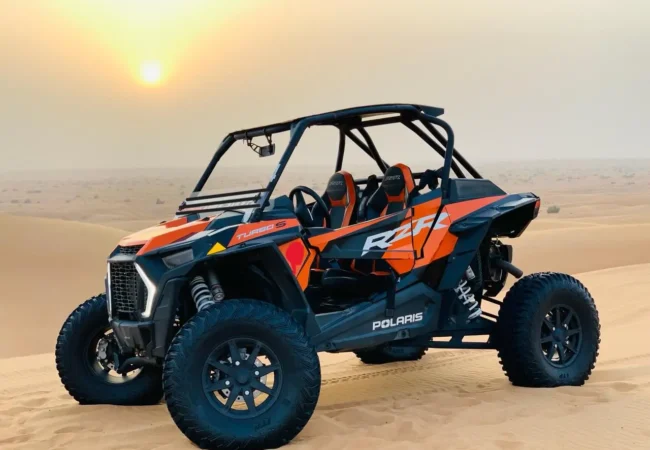
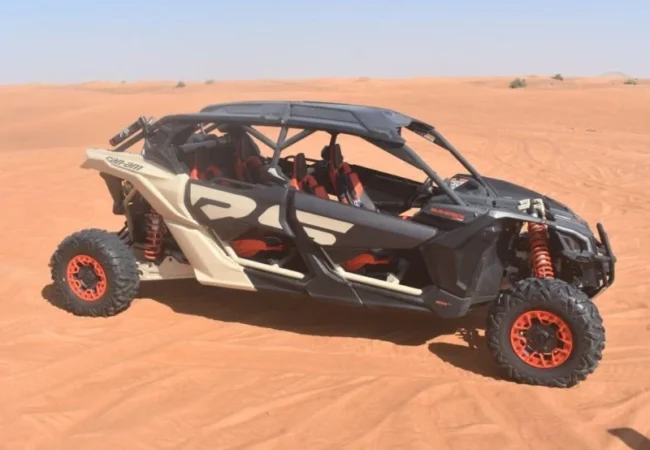
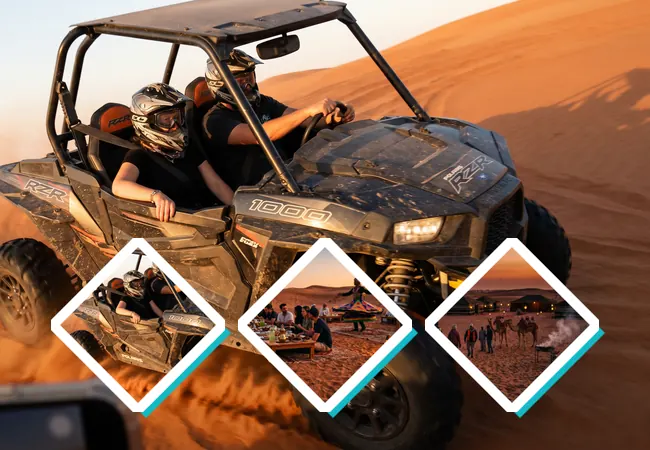
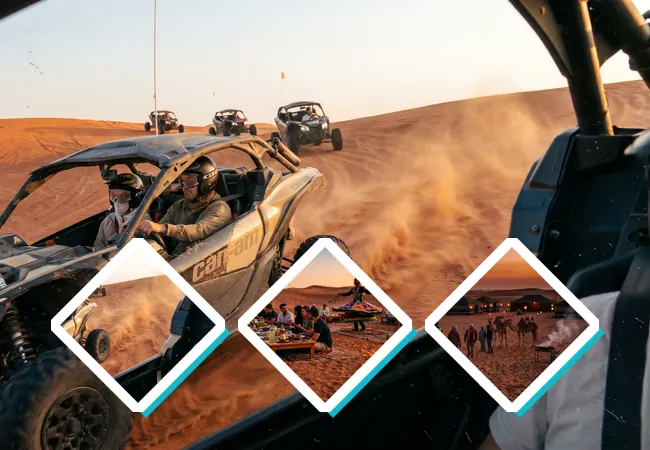
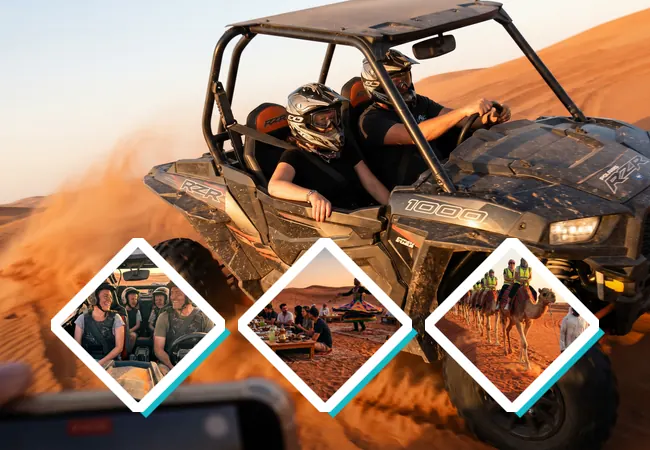
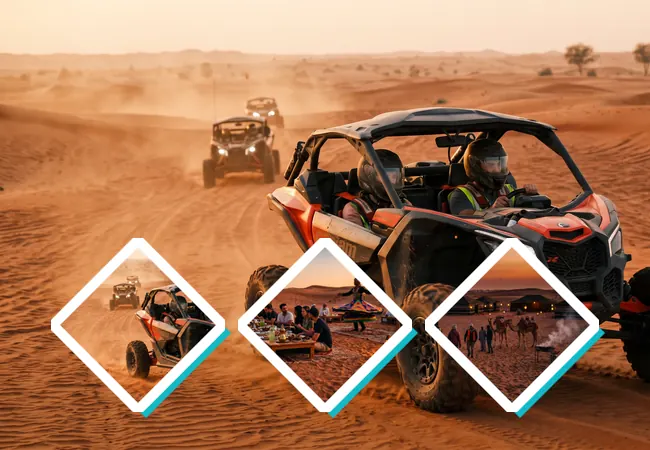
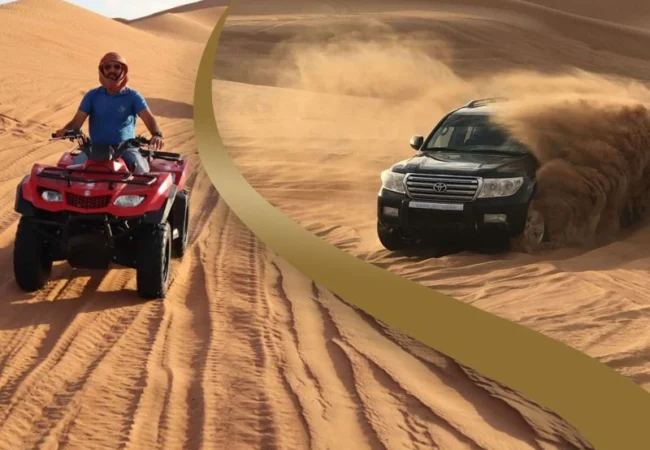
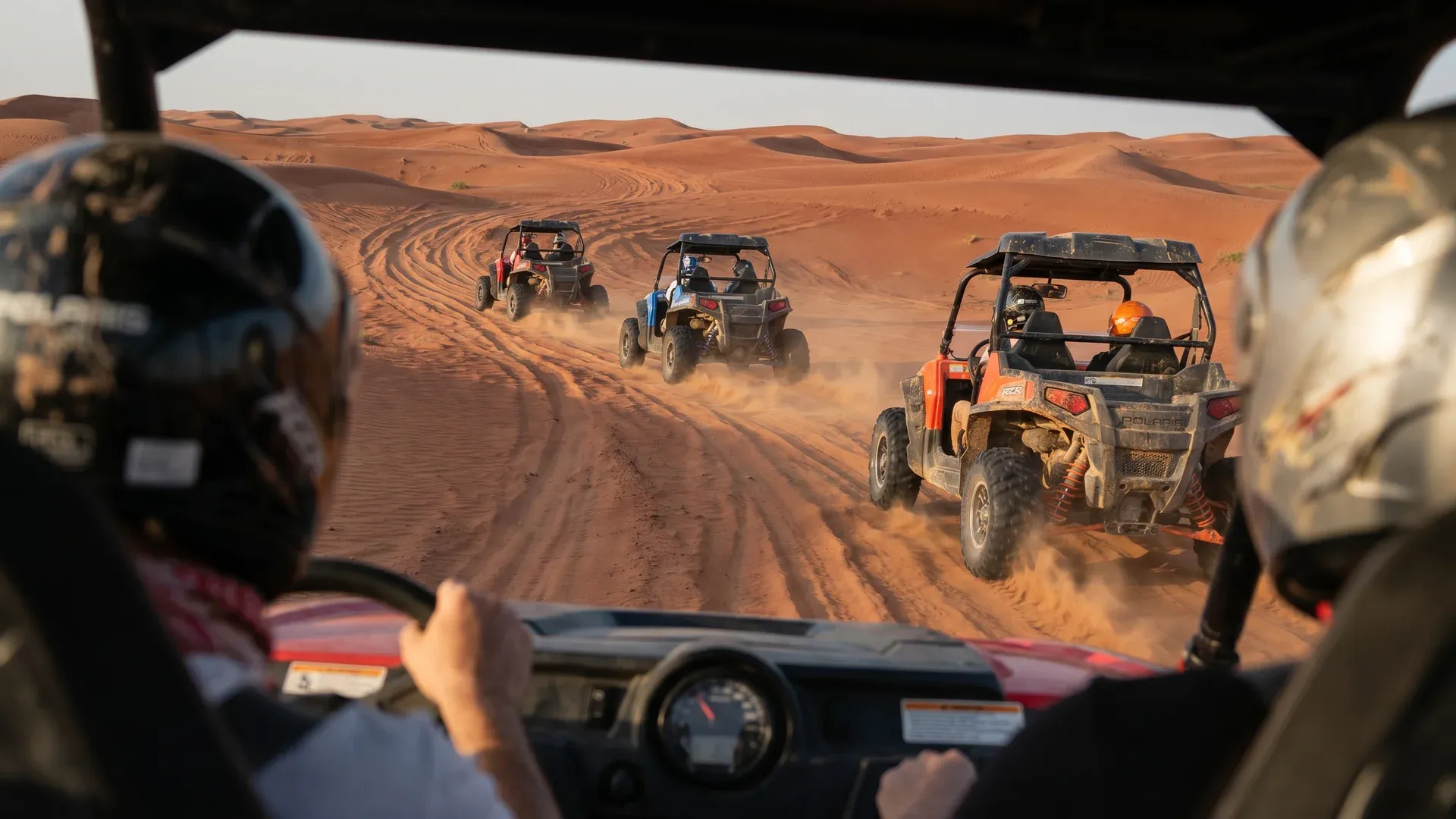
An off-road buggy built for a rocky trail or a farm track is set up to grip a surface that pushes back. Sand doesn't push back the same way. It gives, so a dune-rated machine runs wider, softer-profile tyres designed to float across the top of loose sand instead of digging a trench through it, and the tyre pressure a guide runs out here is nowhere near what you'd use on hard ground. Every Polaris RZR and Can-Am Maverick on this fleet is set up this way before it ever gets rented out, not adjusted afterward on request.
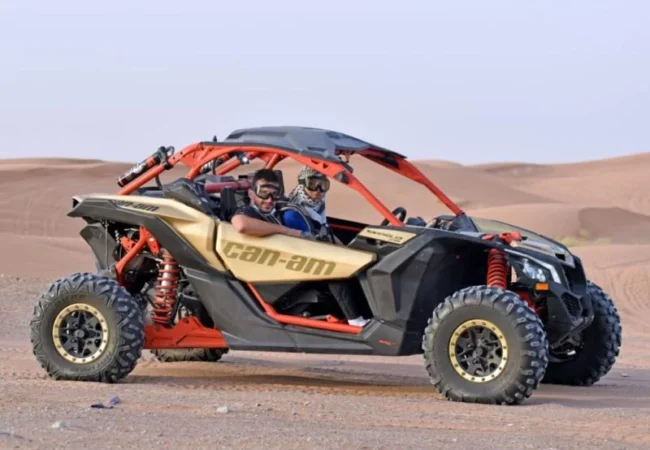
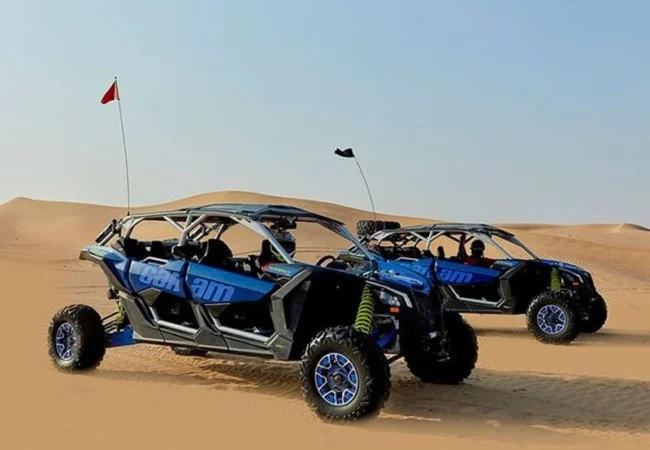
Suspension travel matters just as much as the tyres. A dune face isn't flat, it's a series of crests, bowls and wind-carved ridges, and a buggy landing off one of those needs enough travel in the suspension to absorb the compression without slamming the chassis down or bottoming out the frame. That's the actual difference between the base Polaris and the Can-Am X3 range on this rate card: the X3's long-travel suspension is built to take repeated hits like that all session, where a flat-terrain buggy would start punishing both the machine and the driver within a few climbs.
Engine cooling and air intake are the part renters rarely think to ask about. Climbing loose sand at low speed under full load runs an engine hotter than the same climb on a firm surface would, for longer, and it kicks up far more fine dust into the intake. Dune-rated machines are set up with that in mind, from intake positioning to the filtration behind it. A flat-terrain rental dragged out to Al Lahbab wouldn't necessarily fail immediately, but it would run hotter, dig in harder on soft faces, and wear in ways the rental company never designed for.
None of this is something you can tell by looking at two buggies parked side by side. It shows up the moment one of them is asked to climb a genuinely soft red dune, which is exactly why every machine on the fleet here is specified for this terrain rather than adapted to it after the fact.
Why does the waiver you sign here read differently from a standard off-road rental agreement?
It names dune-specific risks directly — rollover on a descending face, cresting blind over the top of a dune, loss of traction, recovery consent — rather than the generic “off-road use” wording a flat-terrain rental waiver relies on.
A standard off-road rental waiver tends to cover the vehicle in broad strokes: you're operating machinery off paved roads, conditions vary, ride at your own risk. That wording works fine for a gravel trail or a farm track, because the ways a vehicle can actually get into trouble there are fairly limited and fairly obvious. Dune bashing has its own specific failure modes, and the waiver you sign before a rental here spells them out rather than leaving them implied: rollover risk on a steep descending face, the danger of cresting a dune blind without knowing what's on the other side, and the loss of traction that can happen on a climb if the throttle gets lifted at the wrong moment.
The other thing a dune-bashing waiver covers that a flat-terrain one usually doesn't is your obligation to the guide. Because the lead guide is choosing the route in real time and reading conditions you can't see from inside a harness, the waiver includes your agreement to follow the guide's line and hand signals rather than picking your own path across a face. On an open trail rental, that kind of clause wouldn't make sense, because there's no lead vehicle setting a route to begin with.
Health and fitness declarations get more specific too. Dune bashing involves repeated jolts and side-to-side loading in a way a straight trail drive doesn't, which is why the same medical questions — pregnancy, recent surgery, back or neck conditions — carry more direct language here than they typically would on a rental form for flat ground. It's worth reading before you book if anything in your group falls into a grey area, rather than raising it for the first time at the briefing.
Why can't you just rent an off-road buggy and drive yourself out to the dunes?
Permits, terrain knowledge and recovery all sit with the operator, not with a rented vehicle. Al Lahbab isn't open public land you can simply drive a rented buggy onto and explore alone.
Al Lahbab is managed desert land, not an open public off-roading area. Running vehicles out there happens under the operator's own arrangement with the land, which is also why every session here is guide-led rather than a case of handing over keys and a general direction. A rented buggy on its own doesn't come with permission to be on that sand; the rental and the access to ride it are effectively the same booking.
Terrain knowledge is the part that's hardest to fake. A dune face that looks rideable can be freshly wind-loaded and soft underneath, while one that looks identical fifty metres away can be firm from being packed down by traffic. Guides who ride this same stretch of desert daily know which faces are currently good and which ones went soft after last night's wind, and that knowledge doesn't come bundled with a rental key. It's built from being out there constantly, and it's the actual reason a self-guided first attempt at dune bashing goes wrong more often than a guide-led one.
Recovery is the part that matters most if something does go wrong. A buggy stuck alone in a bowl with no support vehicle, no tow strap, and nobody who knows the fastest way back to the road is a genuinely bad place to be in Dubai heat, especially with patchy phone signal once you're low between dunes. The reason a dune rental here always includes a lead guide and a recovery vehicle on standby is that this infrastructure has to already be on-site before anyone starts driving, not arranged after someone gets into trouble.
How do dune steepness and softness decide which rental machine you're actually given?
Steeper, softer faces need more torque and float to climb without digging in. Renters get matched to a machine and a route during the warm-up check, not purely by what they ask to book.
Soft sand needs momentum and a wide footprint to stay on top of it; lose either one partway up a climb and the tyres start digging a hole instead of carrying you forward. That's the physics behind why a base Polaris RZR gets kept to established, more compacted lines on gentler faces, while the Can-Am X3 RS Turbo RR or the Maverick R get taken onto steeper, softer, less-travelled terrain. Those machines have the torque and suspension travel to actually deal with sand that would bog a smaller buggy down.
What decides which machine and which terrain you actually get isn't only the booking you made, it's what the guide sees during the warm-up. A renter who books the X3 but looks unsteady on the flat ground gets held to gentler faces regardless of what the machine is rated for, because the limiting factor at that point is the driver, not the horsepower under them. Renting the more capable buggy buys eligibility for harder terrain, not an automatic ticket onto it.
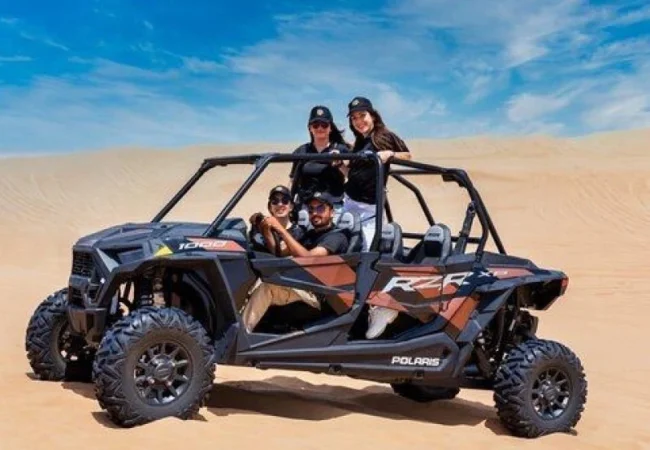
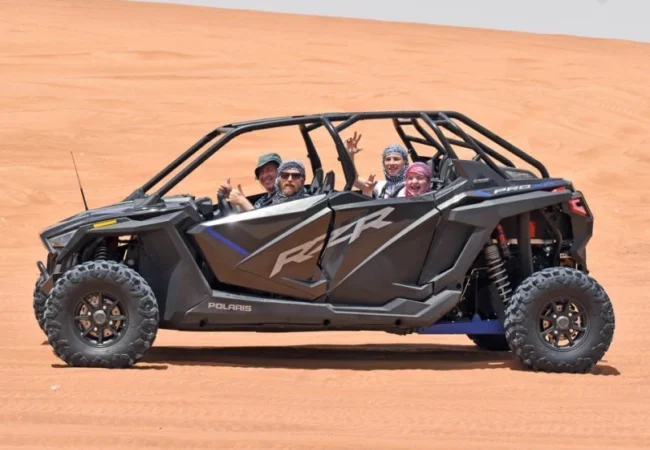
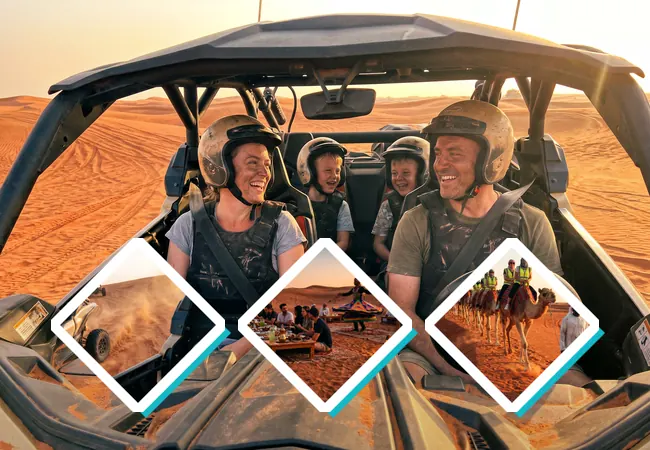
Load changes the equation again. A fully loaded 4-seater rental carries a lot more weight up a soft face than the same chassis with two people in it, which is why the turbo version of the 4-seater exists on this fleet specifically for groups of four adults. Four people in the standard 4-seater on a genuinely steep, soft climb can lose momentum in a way the same group wouldn't in the turbo variant, so the guide factors group weight into the terrain decision as much as the machine's spec sheet.
None of this is guesswork on the day. It's the reason the warm-up exists as a fixed step in every rental regardless of duration, and why two renters on the same machine can end up seeing noticeably different terrain depending on how they handle those first few minutes.
What actually happens if your rented buggy gets stuck or rolls on a dune?
Getting stuck is routine and handled on the spot. A rollover stops the session and triggers a different process — rider check, vehicle check, recovery vehicle — and it's covered under the standard rental, not billed as damage.
Stuck is the common outcome and it's treated that way. It usually happens from losing momentum partway up a soft face, often from lifting off the throttle at the wrong moment, and the fix is straightforward: the guide or the backup vehicle brings a tow strap, the buggy gets pulled clear, and the session continues. It doesn't come out of your booked time in any real sense and it isn't charged as an incident, because it's an expected part of dune driving rather than something gone wrong.
A rollover is rarer and handled differently. The guide signals for the recovery vehicle, the whole group's session pauses, and the rider involved gets checked before the vehicle does. Only once that's clear does anyone look at whether the roll cage and harness point held up the way they're built to, and whether that specific buggy is fit to continue or needs to be swapped out. This is exactly where the dune-specific waiver you signed applies in practice: recovery and inspection are part of the standard rental, not an extra charge, unless what caused it was riding against the guide's direct instruction rather than normal dune conditions.
This is also the clearest example of why the guide-led rental structure exists in the first place. A flat-terrain rental with no lead guide and no recovery vehicle on standby has no equivalent safety net if something similar happened; you'd be dealing with it alone, on sand, in Dubai heat, with whatever help you could arrange yourself. Here, that infrastructure is already parked a short drive from wherever you are on the route.
How is a dune-bashing rental session structured differently from a point-to-point rental?
A point-to-point rental hands you a machine and a destination. A dune session is a loop centred on Al Lahbab, paced by a lead guide, with the actual route decided in real time rather than fixed in advance.
A typical off-road rental works like a car rental: pick the vehicle up somewhere, drop it off somewhere else, and the route in between is yours to plan. That model assumes the terrain in between is stable and self-navigable, which flat trails generally are. A dune session can't work that way, because the terrain itself changes with the wind, so there's no fixed route to hand a renter in advance the way there would be for a marked trail.
Instead, every rental here runs as a loop built around the warm-up bowl, with the guide choosing the actual line through the dunes based on how the sand is sitting that particular day. The warm-up itself is a fixed, non-negotiable step regardless of whether you've booked 30 minutes or three hours; what scales with your rental length is the ride block that follows it, not the structure around it.
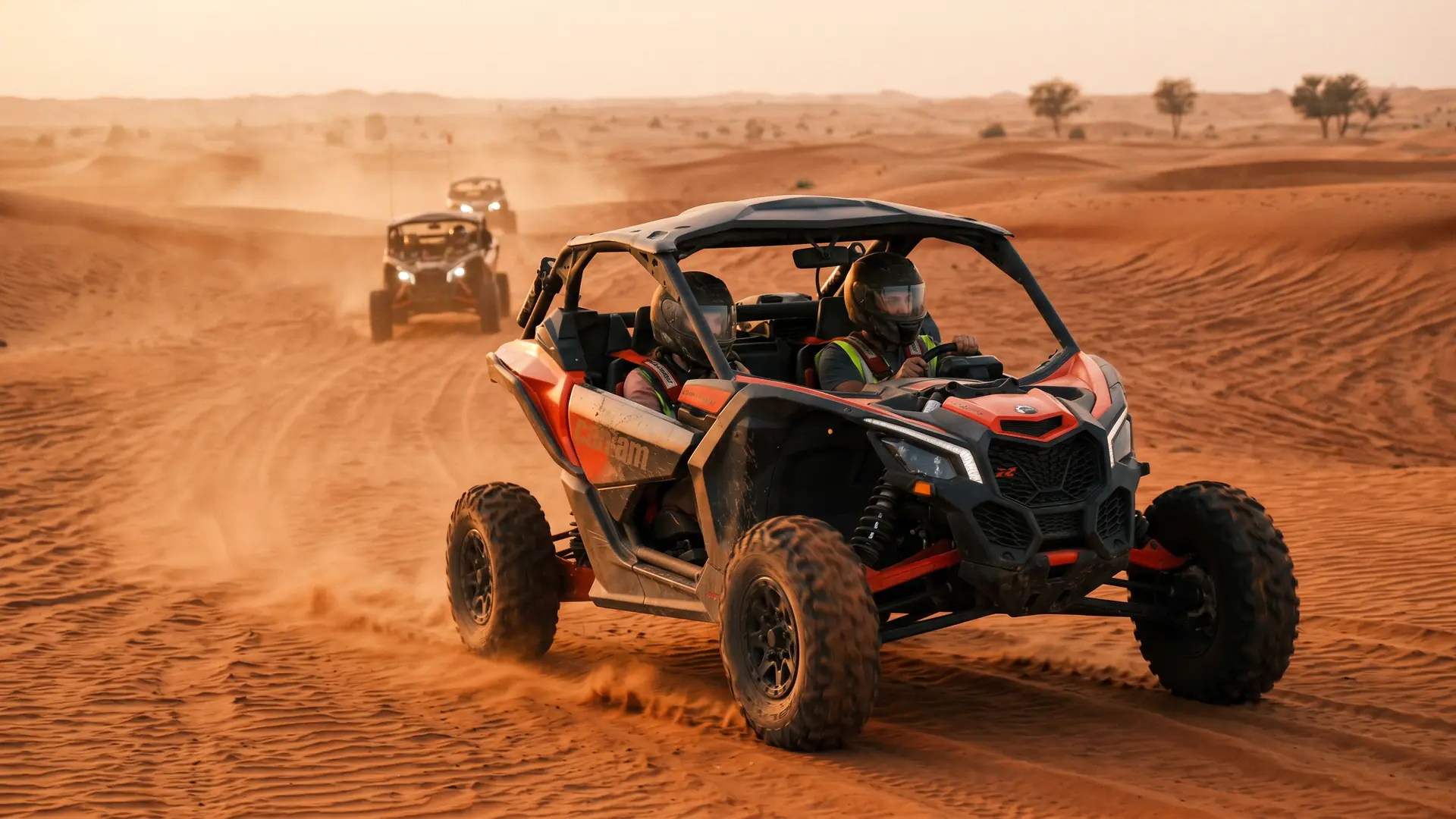
Pacing works differently too. On a point-to-point rental, each renter typically moves at their own speed with nobody coordinating the group. Out here, multiple rented buggies moving at once travel as a convoy behind the lead guide, with spacing and pace set by whoever is riding slowest that day, not by whoever wants to go fastest. That structure is part of what keeps a group session on dune terrain manageable in a way an unsupervised point-to-point rental never has to account for.
What dune-specific safety briefing happens before you're handed the wheel?
Beyond the standard controls walkthrough: how to read a crest before committing to it, why throttle behaviour differs between a climb and a descent, and the hand signals the guide uses to slow, stop or redirect the group.
The controls part of the briefing is what any rental would cover: kill switch, throttle, harness fit. The dune-specific part starts after that. Renters get walked through why you approach a blind crest at reduced speed rather than committing at pace, because you genuinely can't see what's on the far side until you're on top of it, and it might be a steep drop or another rider on the way up. That single habit prevents more problems than anything else in the briefing.
Throttle behaviour gets covered separately for climbs and descents, because the instinct that works on flat ground doesn't transfer. Lifting off the throttle on a climb is the single most common way a rented buggy gets stuck, since it kills the momentum a soft face needs to be climbed at all. On a descent, the opposite mistake causes the bigger risk: carrying too much speed or turning across the face instead of holding a straight line down it, which is how a rollover actually happens.
Because engine noise makes shouting instructions useless once a group is moving, the briefing also covers the hand signals the lead guide uses on the route itself: slow down, stop, follow the exact line ahead rather than choosing your own. This is a piece of the safety briefing that a flat-terrain rental, where you're simply handed a machine and a direction, wouldn't need at all, because there's no convoy to communicate with in the first place.
Everything covered in the briefing gets tested immediately afterward, not left as theory. The warm-up on flat ground is where the guide watches whether what was just explained actually translates into how you handle the machine, and that read is what decides how much dune you see once the real route opens up.
People also search for
Guide FAQ
Does the rental cover recovery if my buggy gets stuck away from the warm-up area?
Yes. Recovery is built into every rental, wherever on the route it happens. There's no separate call-out fee for pulling a stuck buggy free, and your booked time keeps running as normal rather than being docked for it.
Is there a weight limit tied to how a rental buggy handles a dune climb?
There's no published hard number, but weight is a real factor on a soft face. If your group runs heavy, say so at booking and you'll get matched to a loaded 4-seater's turbo version or a machine with more torque to spare.
Do rented buggies get reset for dune conditions between renters?
Yes. Tyres, suspension and the roll cage get checked between sessions, because sand conditions shift through the day as the surface heats and cools, not just from ordinary wear.
Can I request a specific dune or route, or does the guide always decide?
The guide decides, based on how the dunes are sitting that day. Wind reshapes Al Lahbab regularly, so a face that was firm last week can be loose sand this week, and a fixed request isn't realistic the way it might be on a marked trail.
What's actually written into the waiver I sign before a dune rental?
It names the dune-specific risks directly: rollover on a descending face, cresting blind over the top of a dune, loss of traction, and your consent to recovery procedures if needed. It also confirms you'll follow the guide's line and hand signals rather than riding your own route.
Is the insurance on a dune rental different from a standard buggy rental policy?
Cover here is scoped specifically to dune terrain and the guide-led structure, not a generic off-road vehicle policy. It's included in the rental rather than sold as an add-on.
Does renting a more powerful machine mean I automatically get taken onto steeper dunes?
No. A more powerful machine makes you eligible for steeper terrain, but the guide still watches how you actually handle the warm-up before deciding how much dune you get that day.
What happens to the rest of my booking if a rollover ends my session early?
It's handled case by case. The group usually continues if nobody else is affected, and the renter involved is looked after rather than charged for time they didn't get to use.
Are the BBQ combo rentals the same dune-rated machines as the standalone bookings?
Yes, identical specification. The combo just bundles the same rental with the evening camp, dinner and transfers, not a different or lower-spec machine.
Why do some renters get kept to a gentler face even on a powerful machine?
Because the warm-up assesses the person, not just the machine's rating. A nervous first-timer who rents the X3 still starts on an easier line until the guide sees they're settled.
 AED 599